By Richard Peterson
This September marks the third anniversary
of the United Nations Alliance of Civilizations launching its Plan
of Action for the Safeguarding of Religious Sites. First, a brief introduction for those not yet
familiar with the Alliance.
The UN Alliance of Civilizations is
an initiative which was introduced in 2005 by Spain and Turkey. Its political origins
date farther back. The Alliance’s declared purpose is to combat polarization
and extremism worldwide in order to counter the “clash of civilizations” and negate
it with a partnership among civilizations. The Alliance is said to be the “mother
tongue” of the UN system. It is a primary component of the UN Global Counter-Terrorism
Strategy. The Security Council’s statement on the Partnership Among Civilizations
reads “this partnership will represent a powerful response to those who feed on
exclusion and arrogantly claim the sole ownership of truth.” (A/60/341–S/2005/567,
September 2005)
Intercultural and interfaith
dialogue are the primary instruments the Alliance utilizes to advance its agenda.
The Plan of Action for the protection of religious sites emphasizes interfaith
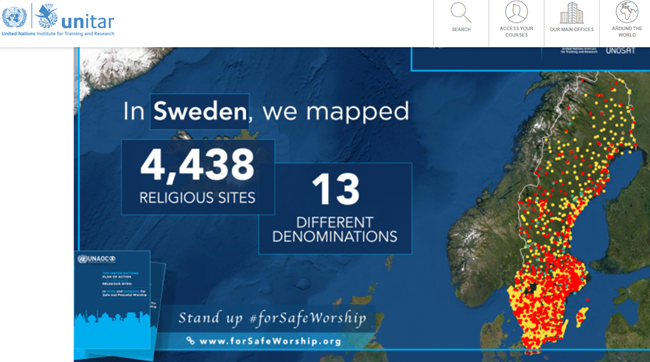
dialogue as a means to combat terror. A significant aspect of the Plan of Action is the worldwide mappings of
religious sites and institutions. Last month, in collaboration with the UN
Satellite Center, the Alliance published the first fruits of this endeavor as it published an
interactive
map of religious sites throughout Sweden.
Should one accept at face value what
is written within the Plan of Action it may sound reasonable. It is difficult to
quarrel with a plan which proposes the safeguarding of religious adherents from
terrorist attacks. The expressed values of human rights, democracy, peace, the
rule of law are ones most would embrace. But what if the language is a veneer which
conceals an entirely different political platform? I have written critical
assessments of the Alliance of Civilizations since 2006 so I propose there
exists an underlying agenda which looks entirely different.
The primary composition of the
Alliance is the High Representative and the High Level Group of eminent
religious scholars.
During the 2006 Alliance Doha
Debates, High Level group members were asked to define extremism for the rest
of the world. This definition becomes important as one assesses the Alliance since
extremism – the root cause of terrorism – is the target. John Esposito defined
extremism as one who believes his or her religious beliefs to be right and
another’s to be wrong. That individual, he said, has adopted the “theology of
hate.” The late Archbishop Desmond Tutu defined
extremism as those who hold their [religious] views exclusive. The Alliance of
Civilizations is especially hostile towards Christianity.
Now align the Alliance’s definition of
extremist thought with the words of Jesus in John 14:6: “Jesus
saith unto him, I am the way, the truth, and the life: no man cometh unto the
Father, but by me.”
High
Level Group member Karen Armstrong lectures that religion has been hijacked by
religious extremists who are abusing religious texts. At the launch of her Charter
for Compassion (an interlocking initiative with the Alliance), she proposed bringing
together all faiths whereby guidelines would be written for how we are to
interpret those abused scriptures. Exactly what constitutes abuse?
I once was
forwarded an email from one of my New Zealand readers. The email was a response
to concerns he expressed to his Minister of Foreign Affairs Winston Peters regarding
the Alliance of Civilizations. Mr. Peters assured this reader Christians had no
cause for concern because the High Level Group had Christian representation,
namely Karen Armstrong and Archbishop Desmond Tutu.
Karen
Armstrong’s representation is less than stellar. In her book In the
Beginning: A New Interpretation of
Genesis, Armstrong expresses theological twists of the absurd. She portrays
God the Creator as a perpetual liar, the evil one, while arguing that the serpent
was so much more truthful. During an interview with Share International (a
voice for the occult organization Lucis Trust), Armstrong argues that
Christians have wrongfully attributed
divinity to Jesus. Similarly, the late Desmond Tutu wrote in God Has a Dream,
A Vision of Hope for Our Time that God gave the poor serpent a raw deal (finding
himself at the end of the line there was no-one left to pass blame). The archbishop’s
writing continued with the admonition that Jesus was never bodily resurrected.
As I first read of the mappings of
religious sites, my first thoughts were that ultimately this will serve to subjugate
religions. Preceding the 2005 Alliance of Civilizations launch, hearings were
held to determine the shape of the initiative. (Note that Lucis Trust was a
participant.) The outcome document
envisions a future where religions be held accountable to an overarching
authority: “religions and the
institutions that represent them cannot be banned from the public sphere but
must be brought in under the leadership of the international civil bodies when
it comes to questions concerning mutual recognition, universal justice, and
lasting peace.” Literature from other interlocking
initiatives envision the same. One such initiative is the OSCE: the Organization for Security and Cooperation
of Europe. The OSCE is an Alliance of Civilizations implementation partner. The
United States is an OSCE signatory nation as well as an Alliance Partner.
While serving as Spain’s Minister
of Foreign Affairs in 2007, Miguel Angel Moratinos also chaired the
OSCE. The OSCE’s Annual Report focused on counterterrorism
by means of interreligious and intercultural dialogue. The report’s concluding
remarks include:
“However, claims to exclusive truth and absoluteness
threaten to damage or even wreck the dialogue of religions. Believers and
religious leaders often fear a weakening of their own religious sensibilities
if other faiths are accepted as potential pathways to “ultimate truths.” The
insistence on the exclusivity of a single true way to salvation devalues other
religious paths and makes dialogue considerably more difficult. Respect and
tolerance with regard to other religions is, however, a fundamental
prerequisite for interreligious dialogue and co-operation. And yet real respect
begins when I can assert my own personal religious truths for myself while
accepting another’s differing religious truth and conviction as authoritative
and valid without restrictions for him.”
Miguel Angel Moratinos presently holds
the position of High
Representative for the Alliance of Civilizations.
In his book Signs of Christ,
Lucis Trust initiate Harold Balyoz wrote of the coming new world religion:
“formerly one said: ‘And my spirit rejoiceth in God, my
Savior.’ Now you will say: ‘And my spirit rejoiceth in God, thy Savior’.
. . Solemnly do I say that therein is salvation. ‘Long live thy God!’ So you will say to everyone; and exchanging
Gods, you will walk to the One…Thus, find the God of each one and exalt Him.”
Several years have passed since I
last wrote of the Alliance of Civilizations. The purpose of this piece is to remind
readers that while the initiative may have diluted its public profile, it has
not gone away. The Plan of Action illustrates it has strengthened.